FeatureProject Authority
Getting the
decision-maker involved in an improvement project at the onset is critical.
This person's role is not time-consuming but integral to the success of the
project.
Chris Boyle discusses project authority in
this month's feature paper.
Read the
complete paper...
Musing
Top-Down or Bottom-Up?1
There are often arguments as to who
should be involved in improvement work, whether improvement efforts should be
top-down or bottom-up. The work simplification approach suggests that these are
NOT mutually exclusive options.
A successful improvement
program NEEDS top-down and bottom-up participation! The vision must come
from the top. Executives must state clearly what they expect to achieve. They
must provide direction and commitment. Direction is offered as an expectation of
the working people to apply their best judgment in performing and improving the
work that they do -- to solidly place the responsibility for the completion and
improvement of the work with the people who do it. Commitment comes two ways --
with an assurance that there will be no loss of employment as a result of
process improvement and with a promise to support the recommendations made by
the improvement teams. This doesn't necessarily mean 100% acceptance (although
upfront approval is a great goal to shoot for), but it does mean approval of all
recommendations that management is not strongly (and validly) opposed to.
It is the person in the role of the Project Authority that makes sure this
happens.
Improvements come from the people closest to the work, the ones who live it and
breathe it day in and day out - the people who do the work. This approach
taps into the process-specific experiences of the people who do the work and
also calls upon external resources for technology-specific expertise and
alternative perspectives. When the operating people
are given the opportunity to participate in an improvement process, their
ingenuity is transformed. Benefits will include reduced resistance, improved
morale and better solutions! Instead of using creativity to thwart changes that
are thrust upon them, they develop creative solutions that they are pleased with
and proud to live with.
If you have comments or
thoughts you would like to share with our readers, send them to:
Here's a
thought...
On the Road to Mastery
Business Process
Mastery Workshops
Two more public workshops are scheduled this year in Dayton, OH...They will
include two days of learning how to understand and improve business processes followed by a day of
hands-on process mapping with Graham Process Charting Software the principal tool for understanding business processes.
US Workshop schedule
...Overview
Software
Graham Process Mapping 7.0 includes several reporting features to help you
manage your Process Map Library.
The Chart Report lists charts and selected details of those
charts. You can select the entire library or a specific folder (including or
excluding subfolders). Audit Reports list those charts due, past due and
scheduled for review. You can search for specific phrases through the entire
library, and the Check Links Report provides a listing of any broken links.
If your organization purchased ANY
prior version of our Professional Edition software, you can upgrade for
just $89.00 US.
Are you ready to try out the best process
mapping software available? You can
download a fully-functional 30-day evaluation copy here:
Graham Process Mapping 7.0
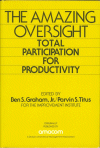
Reading
The
Amazing Oversight: Total Participation for Productivity
Published in 1979 by AMACOM (American Management Association). A
collection of fantastic essays (188 pages) from the pioneers in the field of
participative improvement. While this book has been out of
print for some time, there are several copies available on Amazon for just a few
dollars each.
I wish you the
best with your process work.
Ben B. Graham
ben.graham@worksimp.com
1
Ben B Graham, Detail Process
Charting: Speaking the Language of Process (John Wiley & Sons, 2004) |