|
Feature
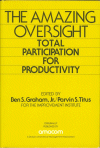
Employee Participation and Work Simplification
Knowledge of
the work itself is crucial to improving the work. The people who do the work
are the best source of that knowledge. So we recommend that employees
participate in work improvement.
In addition to knowledge of the work, it is necessary to approach work
improvement with fresh perspectives. Therefore, knowledge of the work alone is
not sufficient. The two ingredients that combine to produce outstanding
improvements are:
-
Knowledge of the work.
-
Fresh
perspectives for accomplishing the work.
Read the
complete paper... (246K PDF)
Musing
What
is 'Work Simplification'?
Chances are you haven't heard of it.
But from the 1930s into the 1980s, 'work simplification' was what many excellent
organizations were calling their process-focused improvement work. IBM,
Ford, TI, Maytag, Standard Register, John Deere, Remington Rand, US Air Force,
Republic Steel and Caterpillar were just a few of the organizations with work
simplification programs. Work Simplification is defined as 'the organized
application of common sense' or, more completely, 'the organized application of
common sense by everyone to eliminate waste of any kind - wasted time, energy,
space, material, equipment, etc.' Work simplification includes a number of
tools, but the most powerful is the process chart.
Allan Mogensen, the Father of Work
Simplification, points out in his autobiography, "In order to achieve
measurement, tools are needed and the most important of these is the process
chart.…Once a process chart has been drawn up, common sense is all that is
needed to improve efficiency and better the process being examined.…The process
chart then, is the lifeblood of work simplification. It is an irreplaceable
tool. It is a guide and stimulant. It takes time to properly utilize but there
is absolutely no doubt that it works."1
Today, you are more likely
to hear of reengineering, BPI, Six Sigma and Lean, all of which have roots in
work simplification. All contribute new thinking to process improvement.
But, somewhere along the line, the valuable process chart was either discarded
or replaced with high-level program flowcharts. Hopefully, more folks will
rediscover that 'irreplaceable tool' and take advantage of the value it can add
to any process improvement methodology.
If you have comments or
thoughts you would like to share with our readers, send them to:
Here's a
thought...
On the Road to Mastery
Business Process
Improvement Workshops
Two public workshops have now been
scheduled for next year in Dayton, OH... If you are serious about
developing your process improvement skills quickly, join us at one of these
hands-on workshops where you will draw process maps, participate in a
role-playing analysis session and be involved in discussion and exercises that
address all the phases of an improvement project.
Register by December 31 for
either workshop to receive the earlybird special rate of $995.00 (a $200.00
discount) -Call
800-628-9558 today to
reserve your seat.
US Workshop schedule
...Overview
Software
Did you know that
Graham Process Mapping Software is the only process mapping software that was
designed specifically to capture the multiple flows of a business process?
How many significant processes can you think of that use only ONE form or ONE
email OR one database OR ONE report...you get the picture. If you use
Graham Process Mapping Software, you'll see all of the items and how they relate
to each other. If you would like to try out the best process
mapping software available, you can
download a fully-functional 30-day evaluation copy here:
Graham Process Mapping 7.0
If you are using Graham Process Mapping 7.0,
open the About window and click on 'Check for Updates'. This will take you
to the Updates page where you can download the latest update.
Reading
Mark McGregor has recently assembled a fine collection of his
process-related articles as an eBook, 'Winning at Enterprise Process
Management". You can receive a free copy by registering at
www.tinyurl.com/y4ncez
I wish you the
best with your process work.
Ben B. Graham
ben.graham@worksimp.com
1 Allan H. Mogensen with Rosario “Zip” Rausa,
Mogy: An Autobiography (Idea Associates, 1989), 44–46. |